Alt: a telescope and a night sky
Ohio still has rural pockets where the Milky Way, meteor showers, planets, and dense star fields become visible after sunset. Yet enjoying them does not require premium camping gear or a costly cabin. Chasing dark skies in rural Ohio can be a simple overnight drive built around free viewing areas, basic supplies, and flexible plans for unpredictable weather.
Where Can You Find Darker Skies?
Southeastern Ohio offers some of the state’s best-known stargazing areas. Hocking Hills, Vinton County, and parts of Morgan County combine low population density with large stretches of forest and farmland. Northeast Ohio also has accessible astronomy facilities away from Cleveland’s brightest suburban glow.
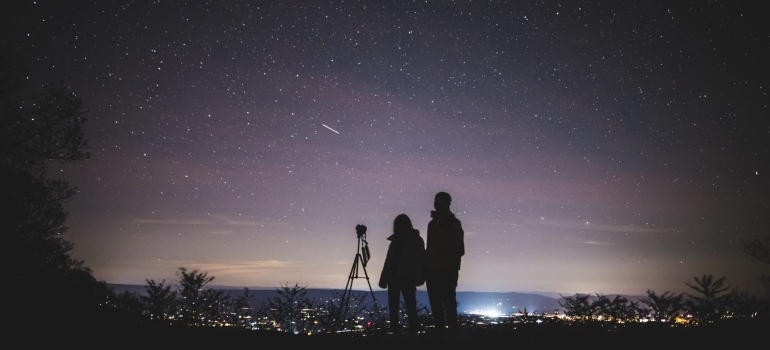
Alt: two people chasing dark skies in rural Ohio
Caption: Chasing dark skies in rural Ohio offers an unforgettable escape without requiring costly camping gear or luxury accommodation.
Good places to consider include:
- John Glenn Astronomy Park, near Hocking Hills State Park
- Grieser Field, within Appalachian Hills Wildlife Area
- Observatory Park, in rural Geauga County
- Stonelick State Park, east of Cincinnati
- Lake Alma and Lake Rupert, in Vinton County
John Glenn Astronomy Park is especially convenient for beginners. Its grounds are open for individual stargazing, while scheduled programs offer guided viewing on clear nights. Parking registration may be required for popular programs, so check current details before leaving.
What Should You Check Before Leaving?
Start with the cloud forecast, moon phase, driving distance, and legal access hours. A nearly full moon can wash out faint stars, even at a genuinely dark location. New-moon weekends usually offer better conditions for seeing the Milky Way and dimmer objects.
A budget trip can become expensive if a preventable breakdown leads to towing or an emergency hotel stay. Review basic vehicle maintenance tips for your budget vacation, including checking the tires, battery, lights, coolant, and fuel level before driving into a sparsely populated area.
Where Should You Stay Overnight?
Choose a modest motel, roadside inn, hostel, or simple cabin within a short drive of the viewing site. The goal is a safe place to sleep, not accommodation with luxury amenities you will barely use.
Location matters more than atmosphere when comparing the best getaways in Ohio for an affordable stargazing trip, especially when the room is mainly a base near a legal viewing area.
Look for accommodation that provides:
- Free parking and late check-in
- Flexible cancellation for cloudy forecasts
- Heating or air conditioning appropriate for the season
- A refrigerator for packed meals and drinks
- A route that avoids long nighttime drives
Splitting one room between friends can cost less than buying camping equipment for a single trip.
Alt: a holiday hostel building
Caption: Stay at an affordable motel, inn, hostel, or basic cabin located close to your chosen stargazing spot.
Can Families Keep the Trip Simple?
Families can treat stargazing as an evening outing rather than a full outdoor expedition. A thermos, folding chairs, blankets, and familiar snacks may be all that younger travelers need.
People accustomed to backpacking with family may already own compact headlamps and layered clothing. Everyone else can bring ordinary household items instead of purchasing specialist equipment. Cover a standard flashlight with red cellophane or use a phone’s red-screen setting.
Children may enjoy the trip more with a short viewing goal. Ask them to find the Big Dipper, identify a bright planet, or count meteors for 20 minutes.
Can the Drive Become Part of the Experience?
A thoughtful route can add interest without increasing the accommodation budget. Small Ohio towns, scenic overlooks, and local museums can turn the daylight portion into a second attraction.
Travelers planning a military history road trip can also look for sites connected with John Glenn, who flew combat missions as a Marine pilot before becoming one of Ohio’s best-known astronauts.
Keep daytime plans light. A packed schedule can leave everyone tired before the stars appear.
What Gear Do You Actually Need?
You do not need a telescope. Binoculars reveal more stars than the unaided eye and can show lunar detail and bright star clusters. Free astronomy apps can identify constellations, although maps should be downloaded before entering areas with weak mobile service.
A practical kit includes:
- Warm layers, even during mild seasons
- Folding chairs or a waterproof ground covering
- Binoculars, if already available
- A red-light flashlight
- Water, snacks, and a rubbish bag
- Downloaded directions
- A portable phone battery
Avoid buying equipment before discovering what you enjoy. Public observing events often let visitors use several types of telescopes. Stonelick State Park, for example, hosts free events where amateur astronomers share their equipment when skies are clear.
How Can You Protect Your Night Vision?
Allow roughly 20 minutes for your eyes to adjust to darkness. Bright phone screens, headlights, and white flashlights restart that process, making faint stars harder to see.
Lower the brightness on every device before arriving. Use red light when walking or reading a map. Keep music off, speak softly, and carry out everything you bring.
How Do You Avoid a Wasted Trip?
Build flexibility into the itinerary. Chasing dark skies in rural Ohio depends on cloud cover, humidity, smoke, moonlight, and local access conditions. No reservation can guarantee a clear sky.
A backup plan might include an early hike, a covered bridge route, a small-town breakfast, or an indoor attraction. Book refundable accommodation when possible.
Only observe from places where nighttime access is clearly permitted. Never assume an empty field, roadside pull-off, or trail remains open after dark. Greiser Field is specifically authorised for nighttime astronomy, while Observatory Park publishes seasonal closing hours.
Alt: people in nature in the dark
Caption: Stargaze only in locations that officially allow visitors after dark.
When Is the Best Time to Go?
Late summer and autumn offer a comfortable balance of longer darkness and manageable temperatures. Winter can bring crisp skies but requires more preparation. Spring is affordable and quiet, although clouds may disrupt plans.
Aim for a clear night near the new moon. Arrive before sunset so you can locate parking and settle in without using bright lights.
Is a Low-Cost Stargazing Trip Worth It?
Yes. The best version is often the simplest: one carefully chosen location, an affordable room nearby, food from home, and enough flexibility to respond to the weather. Equipment can always be rented or purchased later if astronomy becomes a lasting hobby.
By planning around free public sites and bringing only practical essentials, chasing dark skies in rural Ohio becomes an accessible road trip rather than an expensive camping project. The real attraction was overhead all along—and looking up still costs nothing.
